
Marine Protected Areas are crucial for coastal biodiversity, but their effects on species diversity are unclear.
Here, eDNA has been used to assess the impact of 9 marine reserves on 11 biodiversity indicators based on fish traits, phylogeny, and vulnerability to fishing.
Only 3 indicators showed a significant positive effect: functional and phylogenic diversity but also the ratio between demerso-pelagic and benthic species richness.
Why this matters?
The study highlights key nuances in assessing marine reserve effectiveness. It shows that total species richness or elasmobranch richness alone are unreliable indicators, as high species richness with low functional and phylogenetic diversity may signal an unbalanced ecosystem. Additionally, elasmobranchs’ large home ranges often extend beyond reserves, making their diversity a poor metric.
Notably, three eDNA-based indicators emerged as early warning tools for ecosystem shifts. eDNA effectively captures functional and phylogenetic diversity, detecting rare, elusive, and mobile species with distinct traits. Higher diversity in protected areas likely enhances ecosystem resilience and productivity.
Results were published in the Journal of Applied Ecology and can be accessed here.
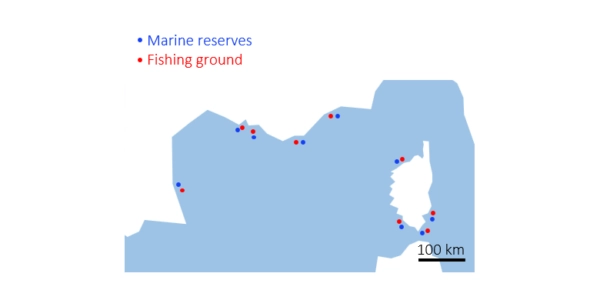
Location: Mediterranean.
Ecosystem: Coastal.
Depth: 0-1 m
Sampling method: via two 30 liter filters on 18 non-overlapping 2 km transects, using two peristaltic pumps on each side of a ship.
Taxonomic group:teleost fishes and elasmobranch fishes, using teleo primers.