Offshore wind energy is a key solution for boosting renewables and achieving a resilient, low-carbon supply. However, its expansion may have environmental impacts, requiring close monitoring.
Here, in a large, shallow, fixed-foundation wind farm of the Atlantic, eDNA metabarcoding showed a fish biodiversity decline one year post-implementation. Ongoing monitoring will assess recovery and determine the potential need for restoration.
Why this matters?
These eDNA-based findings are groundbreaking, revealing that fixed-foundation wind turbines can severely impact marine biodiversity. One year after its launch, fish diversity at the wind farm site was not only lower than in nearby no-take areas but also significantly below that of adjacent fishing grounds, suggesting a likely negative impact on fish stocks.
Ongoing monitoring will determine whether offshore wind turbines can function as artificial reefs enhancing biodiversity, as often claimed, or if their negative effects require concrete mitigation measures.
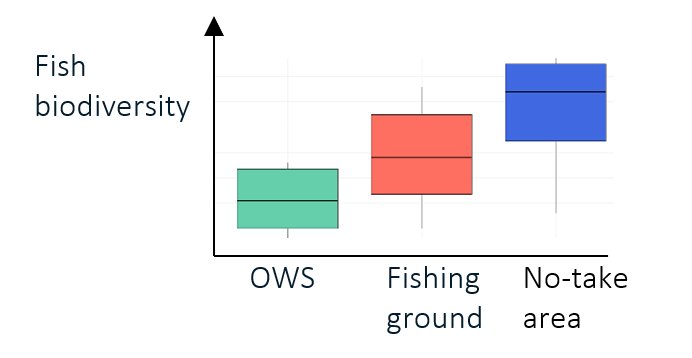
[Image Caption: total species richness in the offshore wind site (OWS; green) and adjacent fishing ground (red) and nearby no-take areas (blue)]
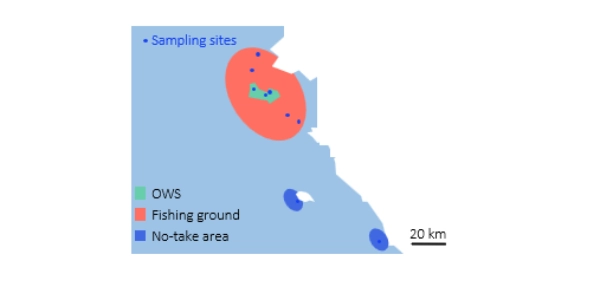
Location: Atlantic Ocean
Ecosystem: Coastal
Depth: 12-25 m
Sampling method: via two 30 liter filters on 9 non-overlapping 2 km transects, using two peristaltic pumps on each side of a ship (surface).
Taxonomic group: fishes and crustaceans, using teleo and Pleo primers, respectively.