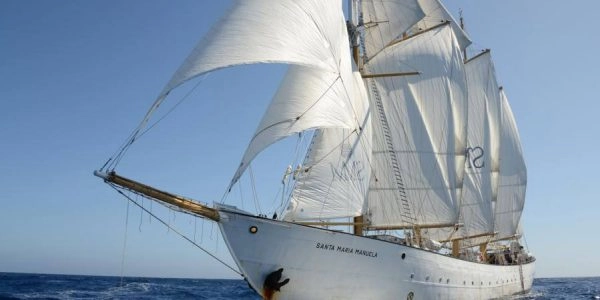
On 24 August 2026, aboard the tall ship Santa Maria Manuela, we filtered seawater off the rocky coast of Flores Island, in the Azores. No nets, no catches, no dive counts: only the DNA that animals shed into the water.
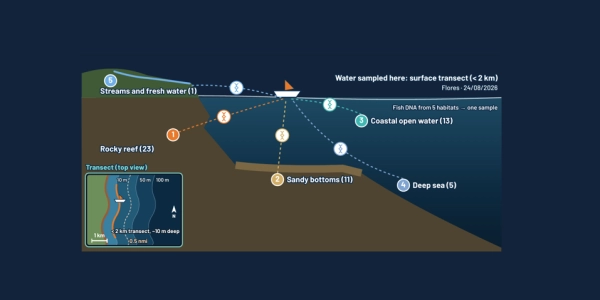
We sampled only the surface: about 30 litres of water filtered along a transect of less than 2 km running parallel to the coast, less than 0.5 nautical miles from shore, over about 10 m of water.
DNA arrived from several habitats, carried by currents and by animals moving through the water column. One sample picked up fish from 5 habitats: rocky-reef dwellers, sandy-bottom species, open-water shoals, deep-sea lanternfishes and even a freshwater-linked eel.
53 fish taxa detected in a single sample, across 34 families, with 41 identified to the species level. Including 4 shark and ray taxa.
Why this matters?
The species list is the starting point. Crossed with conservation status, fisheries use and ecology, it becomes information for ecossystem management:
- Threatened species: we detected 5 species listed as Vulnerable on the IUCN Red List, including the smooth hammerhead (Sphyrna zygaena), dusky grouper (Epinephelus marginatus), common stingray (Dasyatis pastinaca), grey triggerfish (Balistes capriscus), and the bluefish (Pomatomus saltator), without having to see or catch them.
- Signals from the deep: mesopelagic fishes such as the stoplight loosejaw (Malacosteus niger) and several lanternfishes turned up in a coastal sample. This probably happened through vertical migration, currents and the deep slopes close to Flores.
- Notable regional species: the black moray (Muraena augusti), one of 6 Macaronesian endemic fish species found in all the archipelagos, and the Scorpaenodes arenai, a rare scorpionfish known only from the Azores and the Mediterranean.
- Fishery resources: a good part of the list has commercial value, such as European pilchard (Sardina pilchardus), Atlantic chub mackerel (Scomber colias), horse mackerel (Trachurus sp.) and forkbeard (Phycis phycis). This links biodiversity directly to local fisheries.
Discover here the full report.
Location: Flores, Azores (Portugal).
Ecosystem: Coastal.
Depth: ~10 m.
Sampling method: surface sampling of about 30 litres of water filtered on board a dinghy with a peristaltic pump and a 0.2 µm VigiDNA® capsule. Transect of less than 2 km running parallel to the coast, less than 0.5 nautical miles from shore.
Taxonomic group: teleost and elasmobranch (teleo 12S).