This study assessed biodiversity across the full Tree of Life in Mediterranean seaports using multi-marker eDNA metabarcoding, comparing them to nearby no-take marine reserves.
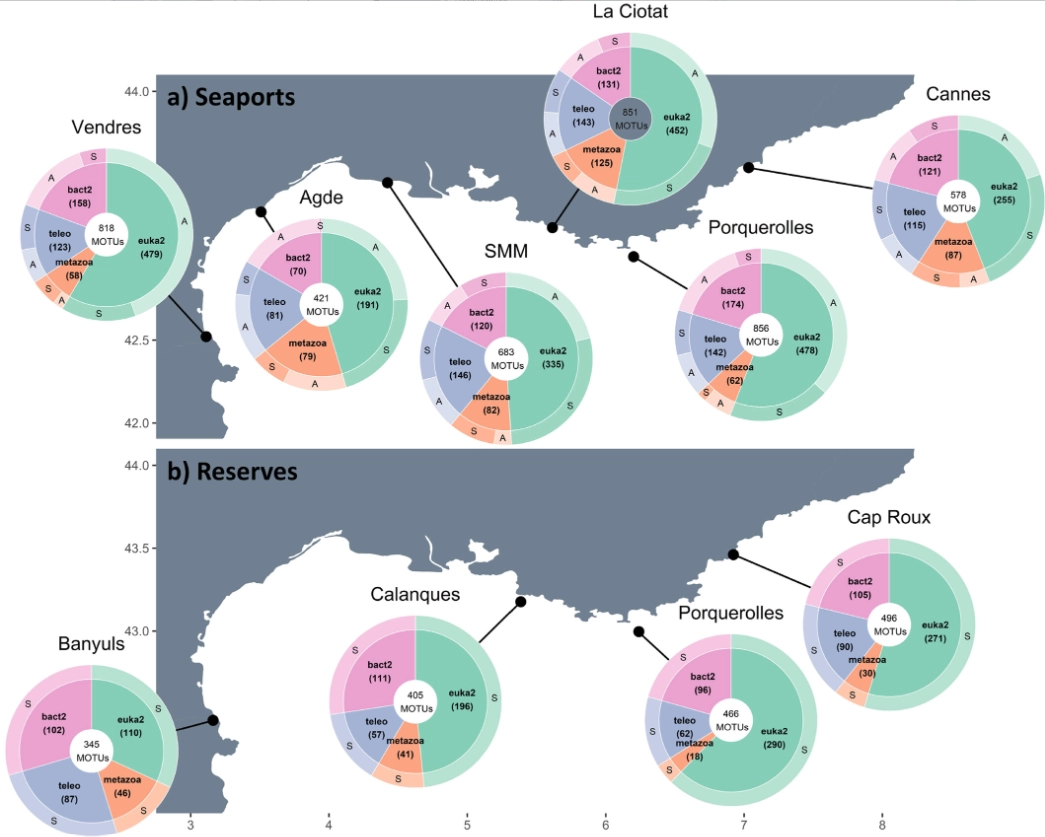
Results show seaports and reserves harbor a similar number of species, but almost entirely different communities.
- Seaports are dominated by opportunistic species adapted to artificial structures: goby fish, mussels and surface-dwelling invertebrates.
- Reserves host a richer, more complex community including wrasse, blennies and a significantly higher richness of threatened fish species.
This pattern holds across all groups sampled, from bacteria to fish. Community composition also shifts substantially between seasons, highlighting the need for multi-campaign monitoring programs.
Why this matters?
This study challenges the assumption that species counts alone are sufficient to characterize port biodiversity. Seaports and marine reserves may look similar on paper, but they host fundamentally different ecological communities across every domain of life.
For port operators and regulators, this means that meaningful biodiversity assessment requires community-level approach, not surveys limited to a single taxon or target species. Threatened species, invasive species, and biodiversity baselines all have direct implications for permitting, certification and risk management.
eDNA metabarcoding is currently the only method capable of delivering this holistic view efficiently, non-invasively, and without disrupting port operations. Seasonal variation in port community composition further reinforces the case for structured, multi-campaign monitoring.
Results were published in Molecular Ecology and can be accessed here.
A Closer Look at MOTUs
Think of Molecular Operational Taxonomic Units (MOTUs) as biological fingerprints: each one represents a distinct organism detected in the water, whether or not we can give it a name.
By comparing these fingerprints, we can tell whether different habitats share the same communities, even when species-level identification isn’t yet possible.
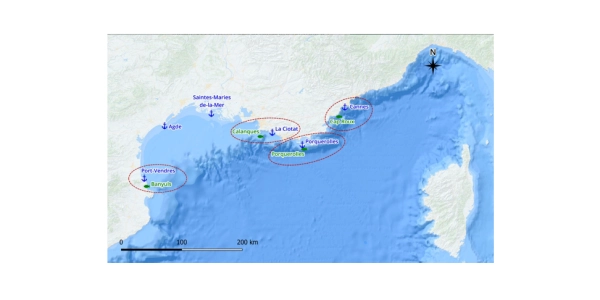
Location: Mediterranean.
Ecosystem: Coastal.
Depth: 0-1 m
Sampling method: 30 liters of water collected via peristaltic pump and filtered through a high-capacity 0.2 µm capsule; transects conducted by kayak covering the full extent of each seaport.
Taxonomic group: teleost and elasmobranch (teleo 12S), metazoans (Kelly 16S), eukaryotes (euka2 18S), and prokaryotes (bact2 16S).