Vertebrates are among the most studied and best-known animals. Yet, in a context of extinction, they are increasingly evading the gaze of observers and revealing themselves essentially through traces of presence such as DNA. Where days of observation were once needed to locate certain animals (with no guarantee of success), a few liters of filtered water now suffice to obtain superior results.
In water, eDNA not only captures the genetic signatures of aquatic species, but also those of semi-aquatic, terrestrial, and aerial organisms. Thanks to their ease of implementation, affordability, and near-zero impact on ecosystems, SPYGEN’s eDNA protocols have become a tool of choice for biodiversity inventories, the detection of target species (whether invasive, rare, or threatened), the study of feeding habits, and the monitoring of the gradual recovery of life in degraded habitats.
Why this matters?
Vertebrates include what we commonly call fish, amphibians, reptiles, birds and mammals. Some of the findings in the Loire River:
- Grey Crane Grus grus: A large migratory bird, it was probably passing through or resting during the sampling period, making its detection by eDNA possible.
- Miller’s Water Shrew Neomys anomalus: A semi-aquatic shrew, rare and discreet, previously unknown at the sources of the Loire. Considered a bio-indicator.
- Yellow-bellied Toad Bombina variegata: An emblematic small toad of the gorges, it frequents the granite pools carved and filled by the Loire.
- Stone Loach Cobitis taenia: An essentially nocturnal fish, it favors sandy bottoms where it hides and feeds. An excellent bio-indicator, it is highly sensitive to sediment pollution.
- Raccoon Procyon lotor: Presence was suspected in the gorges of the Loire, was detected upstream of Puy-en-Velay.
Field sampling by Natexplorers and Conserv-Action. eDNA analysis by SPYGEN. Find out more here.
Location: Entire course of the Loire River, from the foot of Mont Gerbier-de-Jonc to the gates of the Atlantic.
Ecosystem: Freshwater River.
Depth: Surface Sampling.
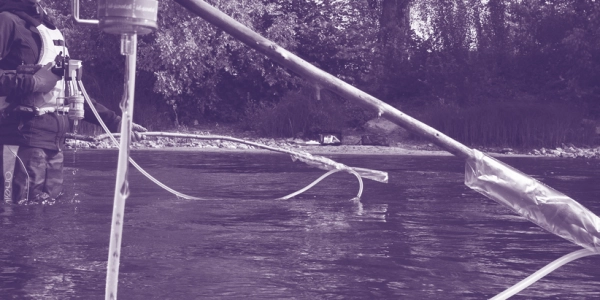
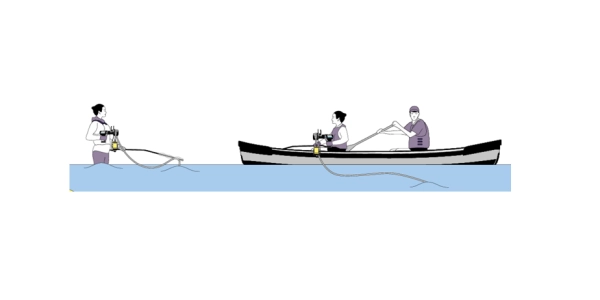
Sampling method: From May-July 2022, 18 study sites spanning 1,000 km were sampled, yielding 36 samples in total. At each site, 2 replicates of 30 liters each were filtered using a 0.45 µm filtration capsule and a peristaltic pump. Sampling was conducted by canoe, from one bank to the other, or on foot where navigation was difficult. In both cases, sampling was performed facing the current to limit the risk of contamination, and slightly below the water surface, where eDNA is found in suspension.
Taxonomic group: Vertebrates, analyzed via SPYGEN’s V05 primer.